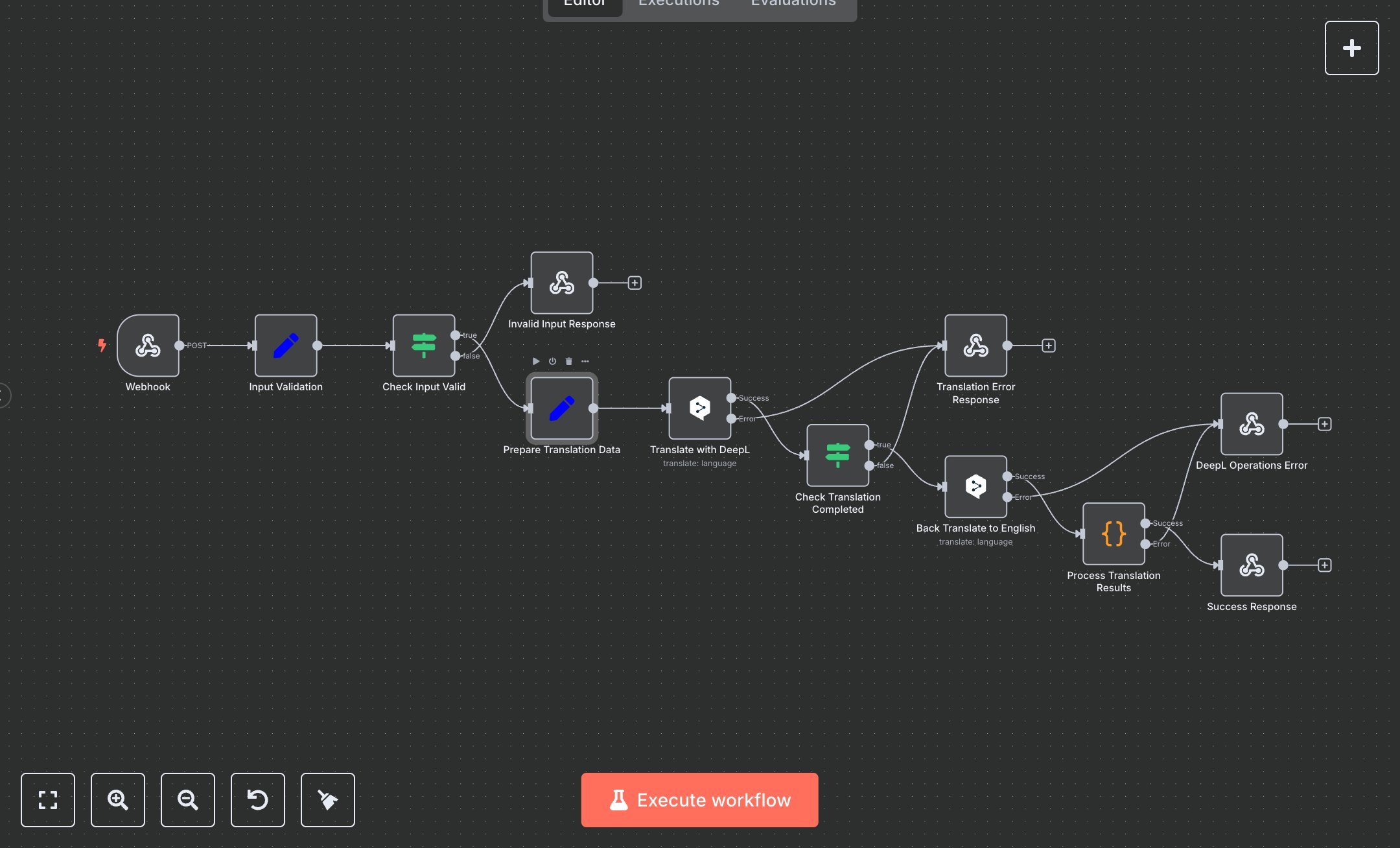
DeepL Translation Automation
This n8n workflow automates text translation using the DeepL API, supporting multiple languages and back-translation. Key nodes include Webhook (receives POST requests), Input Validation (sets parameters), Prepare Translation Data (formats input), Translate with DeepL, Back Translate to English (API interactions), Process Translation Results (data processing), and Success/Error Response nodes (handle outputs). Set up Requirements and Configuration: Install n8n by downloading from n8n.io for self-hosting or sign up at cloud.n8n.io for cloud setup. Follow installation prompts or create a cloud account. Obtain a DeepL API key from deepl.com: sign up for DeepL API Pro, go to 'Account' > 'API,' and copy the authentication key. In n8n, import the provided JSON to create the workflow. Configure the 'Translate with DeepL' and 'Back Translate to English' nodes with your DeepL API key under 'Credentials,' selecting 'DeepL API.' Set the Webhook node’s path to 'deepl-translation' and ensure it accepts POST requests. The Input Validation node verifies valid text, target language, and operations ('translate_text', 'multi_language_translate', 'batch_translate'). Testing and Deployment Steps: Test by sending a POST request to the Webhook URL (from the Webhook node) using Postman. Example JSON body: {'operation': 'translate_text', 'text': 'Hello, world!', 'targetLanguage': 'DE', 'formality': 'formal'}. The 'Success Response' node returns a 200 status with translation details, or 'Invalid Input Response' (400 status) for empty text or invalid languages. If the API key is invalid, the 'Translation Error Response' or 'DeepL Operations Error' nodes return a 502 status. Activate the workflow in n8n’s interface for deployment. Monitor logs for errors like invalid API keys or unsupported languages, and verify credentials or input formats if issues occur.
$5.49
Workflow steps: 12
Integrated apps: webhook, set, if